
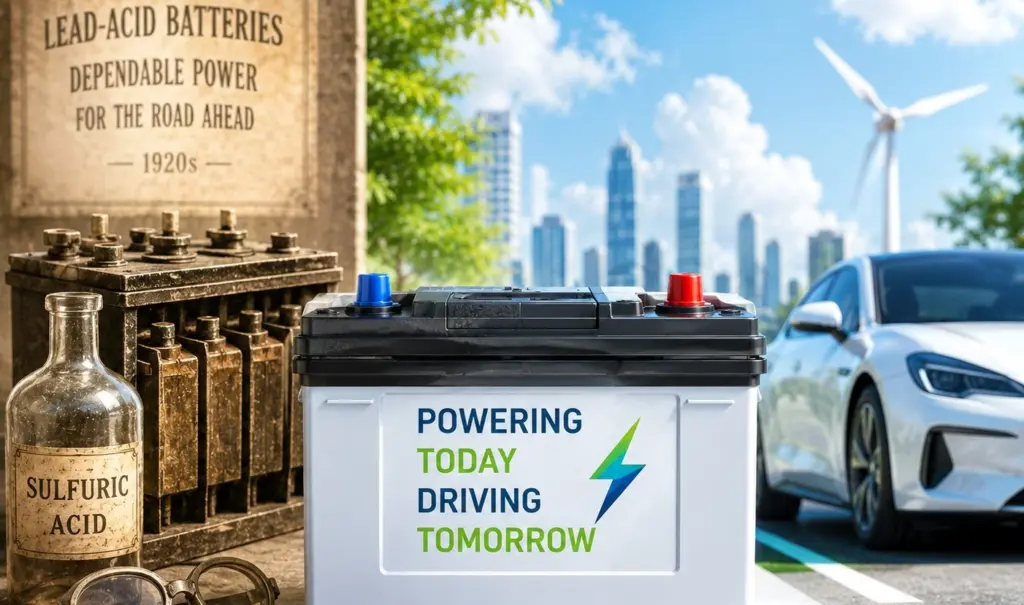
If there were a popularity contest among automotive components, the car battery would finish somewhere between the glove compartment hinge and the rubber mat in the boot. Nobody polishes it, nobody shows it off, and most drivers only remember it exists when the car responds to the ignition with a sound reminiscent of a tired goat – bit like mine did this morning.
Yet this unassuming box is arguably one of the most important inventions in modern mobility. Without it, cars would still be cranked by hand, electric vehicles would remain a Victorian curiosity, and the modern automobile – stuffed with computers, sensors, and enough electronics to embarrass a spacecraft – would simply refuse to wake up.
The story of the car battery is, in fact, the story of electricity itself: a tale that begins with curious scientists poking frogs, wanders through acid-filled experiments in the nineteenth century, and arrives in the twenty-first century powering vehicles that can outrun Ferraris while barely making a sound.
It’s a surprisingly dramatic journey for something that spends its life hiding under the hood.
The Spark That Started Everything
Our battery story begins with the Italian physicist Alessandro Volta in 1800. Volta’s invention, the voltaic pile, was the world’s first true battery – layers of zinc and copper discs separated by brine-soaked cloth.
It looked like a stack of damp biscuits and smelled faintly alarming, but it produced a steady electrical current. This was revolutionary. Until then, electricity had largely been a laboratory trick, useful mainly for making wigs stand on end at dinner parties.
Volta’s invention gave scientists a controllable source of electricity. Unfortunately, it was not particularly practical for powering anything more demanding than a telegraph experiment or an overly enthusiastic academic demonstration.
Still, the seed had been planted.
Enter the Rechargeable Battery
The real breakthrough came in 1859, when the French physicist Gaston Planté invented the lead-acid battery.
Planté’s design was the first rechargeable battery, and remarkably, it still forms the basis of most car batteries today. His system used lead plates immersed in sulfuric acid, producing electricity through a reversible chemical reaction.
In other words, when the battery ran down, you could recharge it instead of throwing it away – an idea that seemed almost magical at the time.
Planté’s battery had several advantages:
-It could deliver large bursts of current.
-It was relatively cheap to produce.
-It was rugged enough to survive industrial use.
The only downside was that it involved lead, acid, and the occasional tendency to explode if mistreated. But engineers are generally willing to overlook such minor inconveniences.
The First Electric Cars
Surprisingly, electric vehicles appeared long before petrol cars dominated the roads. In the late nineteenth century, electric carriages powered by lead-acid batteries were actually quite popular in cities. They were quiet, clean, and easy to operate – qualities that petrol cars, which required manual cranking and smelled like a refinery accident, could not match.
One famous example was the electric car developed by Thomas Edison’s rival engineers, which used early battery systems for urban transportation.
For a brief moment in the early 1900s, electric vehicles seemed poised to win the race. Then petrol engines improved dramatically.
The arrival of mass production – pioneered by Henry Ford – made petrol cars cheaper and more powerful. Meanwhile, oil was plentiful and batteries remained heavy, expensive, and somewhat unimpressive. Electric cars faded into obscurity, leaving batteries with a more modest role: starting internal combustion engines.
The Rise of the Starter Battery
Ironically, the car battery’s greatest early success was helping petrol cars avoid embarrassing their drivers.
Before 1912, cars were started using a hand crank. This involved standing in front of the vehicle and physically turning the engine over. If the engine backfired – which happened frequently – the crank could spin backward with enough force to break a wrist. This was considered normal.
The solution arrived when Charles F. Kettering developed the electric starter motor. Suddenly, drivers could start their cars simply by turning a key. The lead-acid battery became essential.
From that moment onward, every petrol vehicle needed one. The battery powered:
-the starter motor
-the ignition system
-lights and electronics
Even today, in a traditional car, the battery’s job is simple but crucial: provide a burst of power to start the engine and stabilize the electrical system.
Without it, your car is essentially a large metal sculpture.
Batteries Get Busy
As cars became more sophisticated, the humble battery quietly took on more responsibilities.
Modern vehicles contain dozens of electronic systems:
-engine management computers
-navigation systems
-power steering
-advanced safety sensors
-infotainment systems
-heated seats (because apparently our ancestors suffered unnecessarily)
All of these rely on electrical stability provided by the battery and alternator system.
Even in cars powered primarily by petrol, electricity has become indispensable.
But the real transformation came with the return of the electric vehicle.
The Lithium Revolution
Lead-acid batteries are excellent for delivering high bursts of power but terrible for storing large amounts of energy. They are heavy, bulky, and not particularly efficient.
Enter the lithium-ion battery.
This chemistry, first commercialized in the 1990s, stores far more energy for its weight. The technology was developed through decades of research by scientists including John B. Goodenough and Akira Yoshino.
Lithium-ion batteries offered:
-higher energy density
-lighter weight
-longer lifespans
-faster charging
Suddenly, electric vehicles became viable again. And that is where the story takes a dramatic turn.
The Electric Car Comeback
For most of the twentieth century, electric vehicles were dismissed as impractical curiosities. Then along came Elon Musk and the company Tesla, Inc..
Tesla’s vehicles demonstrated that lithium-ion batteries could power high-performance cars capable of traveling hundreds of kilometers on a single charge.
The Tesla Model S shocked the automotive world when it proved that electric cars could be faster than many sports cars. Suddenly the battery was no longer a quiet helper hiding under the hood. It became the car. In an electric vehicle, the battery pack is the largest and most expensive component. It determines:
-range
-performance
-charging speed
-lifespan
-overall cost
In other words, the entire future of the automotive industry now depends on battery technology. Not bad for a device that once spent its life starting engines.
How EV Batteries Actually Work
Modern EV batteries consist of thousands of small lithium-ion cells arranged into modules and packs. Inside each cell, lithium ions move between electrodes during charging and discharging. This movement generates electrical energy that powers the vehicle’s motors. A large battery pack in a modern EV might store 60–100 kWh of energy – enough to drive several hundred kilometers.
The engineering challenge lies in controlling:
-heat
-charging rates
-battery degradation
-safety
Because lithium batteries are energetic little creatures. Treated properly, they power your car. Treated badly, they can attempt to imitate fireworks.
Manufacturers therefore use sophisticated battery management systems to monitor temperature, voltage, and charge levels.
Your car is basically babysitting thousands of tiny chemical reactors.
The Global Battery Race
As electric vehicles surge in popularity, countries and corporations are racing to develop better batteries and companies such as Toyota Motor Corporation, BYD Company, and Volkswagen Group are investing billions into battery research.
Their goals are clear:
-longer range
-faster charging
-lower cost
-improved safety
The battery is now the strategic heart of the automotive industry.
Entire “gigafactories” are being built around the world to manufacture them.
The Next Generation of Batteries
Researchers are currently exploring several promising technologies that could transform the industry yet again.
Solid-State Batteries
One of the most anticipated breakthroughs is the solid-state battery. Instead of using a liquid electrolyte, these batteries use a solid material to conduct ions. This could dramatically improve:
-safety
-energy density
-charging speed
Companies like Toyota Motor Corporation claim solid-state batteries could double EV range while charging in minutes rather than hours. If they succeed, range anxiety may disappear almost overnight.
Lithium-Sulfur Batteries
Another promising candidate is the lithium-sulfur battery.
These batteries could store significantly more energy than conventional lithium-ion cells while using cheaper materials. The downside is that they degrade quickly, but researchers are making progress. If solved, they could produce lighter EV batteries capable of powering aircraft as well as cars.
Sodium-Ion Batteries
Lithium is effective but relatively scarce and expensive.
Sodium-ion batteries, currently being developed by companies including CATL, replace lithium with sodium – an element that is vastly more abundant. These batteries may offer lower cost and improved sustainability, making electric vehicles accessible to more consumers.
Structural Batteries
One of the most futuristic ideas is the structural battery.
Instead of placing a battery pack inside the vehicle, engineers are experimenting with materials that store energy while forming part of the car’s structure. Imagine the body panels or chassis of a car functioning as the battery itself.
It sounds like science fiction, but research teams and companies including Tesla, Inc. are actively exploring similar concepts. If successful, vehicles could become dramatically lighter and more efficient.
Recycling: The Next Challenge
As millions of electric vehicles reach the roads, the world faces another issue: what happens when batteries wear out? Fortunately, lithium-ion batteries are highly recyclable. Companies such as Redwood Materials in the USA are developing processes to recover valuable metals like lithium, cobalt, and nickel from used battery packs. Recycling could create a circular supply chain where old batteries become the raw materials for new ones. In other words, your future car battery may contain atoms that once powered someone else’s vehicle. Which is oddly poetic.
The Battery That Changed the World
It is easy to overlook the car battery because it does its work quietly. Turn the key – or press the start button – and the vehicle obediently wakes up. No drama. No applause. Just electricity flowing exactly where it needs to go.
But behind that simple act lies two centuries of scientific discovery, engineering innovation, and chemical experimentation.
From Alessandro Volta’s stack of metal discs to the lithium-powered machines now reshaping transportation, batteries have steadily evolved from laboratory curiosities into the beating heart of modern mobility. Today they power vehicles that produce no exhaust, accelerate faster than supercars, and may soon drive themselves. Frankly, it all seems like a boring future, but then again, I grew up in the age of V6 Fords that a teenage boy could learn to dismantle and reassemble himself with a hammer, two screwdrivers and three spanners!
For most drivers, the battery remains the same mysterious box under the hood. Ignored until the morning, it refuses to cooperate. At which point we remember – usually while standing in a parking lot with jumper cables – that this humble device might just be the most important component in the entire automobile.
Not bad for a box full of chemistry.