
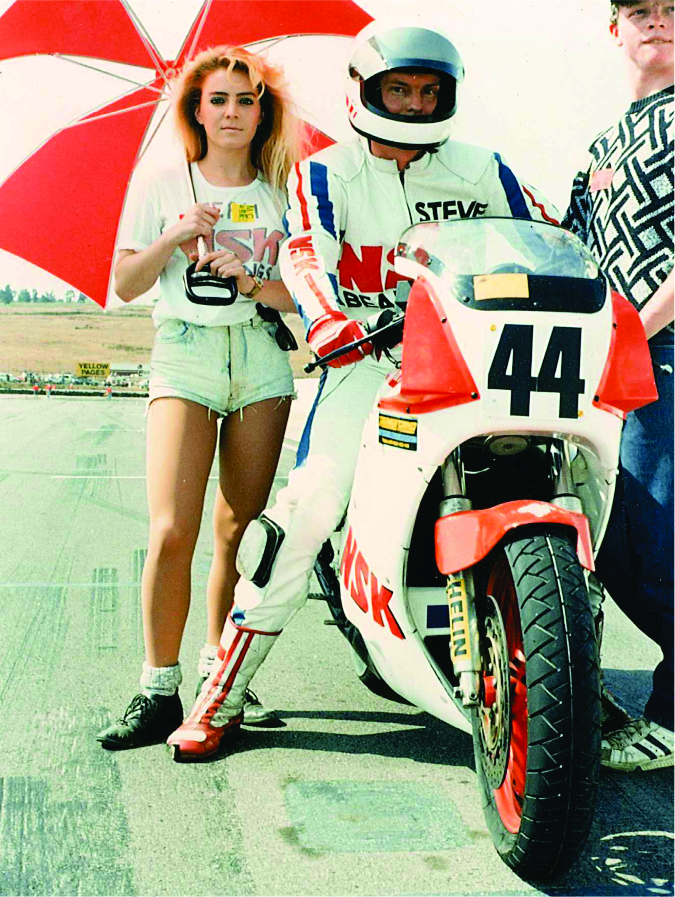
Back in the late 1980s, I was flinging a TZR 250cc Yamaha around the circuits of South Africa, chasing dreams, apexes, and, more often than I’d like to admit, the back end of someone else’s leathers. I raced in the South African and Transvaal championships, when bikes were loud, powerbands were vicious, and traction control came in the form of your right wrist and an occasional prayer.
I still remember the exact moment I got my knee down for the first time in my first race (at the short Zwartkops track outside Pretoria). It was like discovering fire. The sensation was so glorious that I almost forgot to pick the bike up and get on the gas. There I was, cranked over in a corner with my knee slider finally grazing the tarmac, feeling like Kevin Schwantz – until I was swiftly reminded that my Yamaha didn’t come with his talent or tyres. But I got there, eventually, and those memories come flooding back every time I watch a MotoGP race today.
The contrast between what we rode then and what the aliens in MotoGP ride now is staggering. Watching the evolution unfold over the decades has been equal parts inspiring and bewildering. You see, back in ‘my day’ – cue violins – we didn’t have data engineers or GPS telemetry. We had a few spanners, a pair of steel cojones, and a vague idea of the correct tyre pressure. (Thank God the Wooley brothers were available for advice) In my case, I was lucky to have new tyres for the race, I mean, they cost up to R100 a tyre!!
The Two-Stroke Jungle – Where Men Were Men, and Powerbands Were Treacherous
In 1985, the pinnacle of motorcycle racing was the 500cc two-stroke class, and to call those bikes beasts would be an insult to actual beasts. They were light, twitchy, and delivered power in a way best described as “delayed violence.” One second you were rolling on smoothly, the next you were airborne – rear tyre spinning, front wheel pointing skyward, and your mechanic already reaching for the crash spares.
The tyres weren’t much help either. Narrow, rounded, and seemingly made from recycled hockey pucks, they offered modest grip and plenty of opportunities to explore the limits of high-siding. You didn’t so much lean into corners as tiptoe around them. Getting on the gas too early or too hard was a fast track to a somersault. I may be exaggerating here, but compared to the tyre technology of today . . !
In 1989 radial tyres were suddenly available, and changing to a set shaved nearly a second off my best time around the Long Zwartkop track. For anyone who hasn’t raced a bike, that was a big deal!
Watching the likes of Wayne Rainey, Kevin Schwantz, and Mick Doohan master those savage machines was like watching tightrope walkers juggle chainsaws. And in some weird way, it made me feel better about the times I found myself skimming across Midvaal or Kyalami on my backside.
The Four-Stroke Awakening. When the World Got Smoother (But Not Slower)
Then came 2002 and the birth of MotoGP proper – the start of the four-stroke era. Suddenly the snarling two-stroke scream was replaced by a deeper, throatier growl.
The 500cc 2-stroke machines had gone about as far as they could and lap records were stagnating year after year. The 990cc four-strokes were bigger, heavier, and smoother, but just as fast – if not more so. And while they were easier to ride in theory, it quickly became clear that “easier” was a relative term.
Valentino Rossi famously adapted instantly, winning titles and wheelies with equal style. The new bikes had traction control, launch control, engine mapping – all the things we never even dared to imagine when we were stuffing rags into airboxes trying to get an extra tenth down the straight.
It was around this time that I began to notice something else: the way riders moved on the bike was changing. They were hanging off more, dragging knees like it was going out of fashion. And by the time Casey Stoner and Dani Pedrosa were at their peak, elbows were getting dangerously close to the deck too. Scott Redding famously scraped his helmet on the track surface through a corner while riding the Aprilia MotoGP bike!
Enter the Data Nerds (And Michelin)
As the years rolled on and the four-strokes settled into the 800cc phase (a brief but frantic era), MotoGP became a tech arms race. Seamless gearboxes, carbon brakes, launch-control, and more buttons on the handlebars than my microwave. And let’s not forget tyres.
Tyres, it turns out, shape the entire riding style. In the Bridgestone era, the front tyre was the king. You could brake deep, carry absurd corner speed, and trail brake with the confidence of a saint. Riders would dive into turns like missiles, counting on that front end to hold while the rear drifted obediently behind.
Then Michelin took over in 2016 and changed everything again. Their rear tyre offered massive grip, but the front was twitchier. Suddenly, exits were more critical than entries. The style shifted again – now it was all about squaring off corners, picking up the bike early, and launching out with all the traction the Michelin rear could muster.
Of Winglets and Wizardry
If someone had told me in 1989 that motorcycles would one day sprout wings like F1 cars, I would’ve laughed, adjusted my scarred helmet, and changed my spark plugs again. But here we are. Modern MotoGP bikes look like stealth bombers. Aerodynamics now manage wheelies, stabilise braking, and even improve cornering. It’s no longer just about horsepower – it’s about downforce.
Add in ride height devices that lower the bike under acceleration like a dragster at the lights, and you’ve got machines that resemble something from a Star Wars film more than the oil-leaking Yamahas I used to coax around the track.
And of course, it’s not just the bikes – riders today are part athlete, part test pilot, part computer analyst. They review data after every session, work with tyre technicians and software engineers, and still find time to scrape their elbows while leaning over at angles that defy physics.
The Style Shift – From Wrestlers to Ballerinas (With Bigger Balls)
Watching old races from the 1980s and early 1990s feels like watching bar brawls. The riders wrestled their bikes, slid both wheels, earned nicknames like ‘The Sultan of Slide’ and made it all look terrifying. Today’s style is more like ballet – every movement measured, controlled, and beautifully executed. But don’t let the finesse fool you – these guys are still risking it all, just with more tools at their disposal.
Riders like Marc Márquez took the modern style to new levels. He brakes so late you’d swear he missed the corner, leans over so far you think he’s fallen off, and then uses his elbow as a third wheel to keep the bike up. It’s a long way from the “point and squirt” technique we used when we didn’t trust our own back tyres to stay connected.
Back Then v Now
So what’s changed? Everything – and nothing.
Yes, the bikes have evolved from unpredictable two-stroke lunatics to digital-age monsters brimming with tech. Yes, the tyres now offer grip levels we couldn’t dream of. And yes, today’s riders move on the bike in ways that make my hips ache just watching.
But deep down, the soul of racing is still there. It’s still man (or woman) versus machine, versus tyre, versus track, versus physics. It’s still about commitment, precision, and that mad urge to go faster than anyone else on the day.
When I watch MotoGP now, I do so with equal parts awe and nostalgia. I see the echoes of my own racing days in the way riders approach a corner, even if they’re hanging off like trapeze artists and backed by an army of data analysts. I nod in appreciation, laugh when they high-side (in sympathy, of course), and still get goosebumps when someone makes a pass stick at full lean. Oh, and the European manufacturers have wrestled control of motorcycle racing from the Japanese – and the Chinese manufacturers are watching, waiting, and getting ready to pounce!
Final Thoughts From the Saddle (and the Sofa)
Motorcycle racing has changed dramatically in the past 40 years, but the essence remains. From knee sliders to winglets, from rough two-strokes to seamless gearboxes and smart tyres, each step has brought new styles and new heroes.
For me, the thrill of that first knee-down moment in a Transvaal corner still ranks up there with watching Márquez slide both wheels at Sachsenring.
They’re separated by decades and light-years of technology, but somehow, they’re still the same story: a rider, a machine, and the beautiful madness of going as fast as possible.
And that, my friends, will never change.