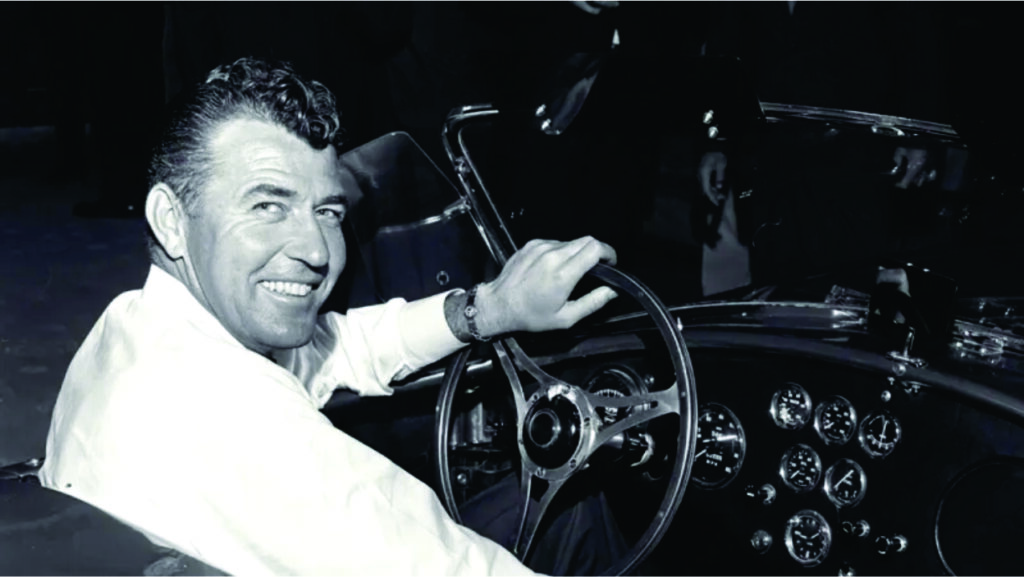
Some people are born to race. Others are born to build. Carroll Shelby was somehow born to do both – and, just for good measure, throw in a stint as a chicken farmer and chilli cook-off champion.
If that sounds like an unusual resumé for the man who helped Ford beat Ferrari at Le Mans, well ……welcome to the extraordinary world of Carroll Hall Shelby.
Born in Leesburg, Texas in 1923 (a terrible place even back then!), Shelby grew up in a small town with big dreams. After serving as a flight instructor during World War II – he flew the Vultee BT-13 Valiant, a basic trainer aircraft widely used to train WWII pilots. It was nicknamed the “Vultee Vibrator” due to its tendency to shake badly.
Afterwards, he dabbled in various pursuits, including chicken farming. Unfortunately, his chickens had little interest in fame or fortune, and the farm flopped. Lucky for us, Shelby turned his attention to motorsport – a field where he would end up rewriting the rulebook.
Shelby’s racing career took off in the early 1950s. With a natural flair for driving and a fearlessness that bordered on reckless, he quickly made a name for himself on the race track. His crowning achievement came in 1959, when he co-drove an Aston Martin DBR1 to victory at the 24 Hours of Le Mans. That same year, he was named Sports Illustrated’s Driver of the Year.
But just as his racing star was rising, his heart was giving out. A congenital heart condition forced Shelby to hang up his helmet in 1960. Lesser men might have retired to a quiet life, but Shelby wasn’t wired that way. Instead, he decided to build the kind of cars he wished he could still drive. Enter the Cobra.
It all started with a problem and a proposal. Across the Atlantic, the British car company AC Cars had a lovely little roadster called the AC Ace. It was lightweight, nimble, and charmingly underpowered. Meanwhile, in America, Ford had a brand-new lightweight V8 engine but no sports car to stuff it into. Shelby, never one to miss an opportunity (or an oil stain), had a lightbulb moment: what if you combined the AC Ace chassis with Ford’s V8 muscle? A sort of vehicular peanut butter and jelly – you’d have to be an American to actually enjoy one of those.
In 1961, Shelby phoned AC – not so easily done back then, it could literally take a day to get the call through – and pitched his idea to the Poms. The Brits were game, provided Shelby could sort out the engine issue.
Off he went to Ford, where executives, keen to build a Corvette-killer, jumped at the chance. With an engine in one hand and a chassis in the other, Shelby created the first prototype: the Shelby Cobra CSX2000.
The result was nothing short of explosive. The Cobra wasn’t just fast – it was scary fast. It looked like a gentleman’s racer but behaved like a bar fight in a tuxedo. The automotive world took notice. The Cobra tore up tracks and test drives alike, earning a reputation as one of the most iconic sports cars of the 1960s.
But Shelby wasn’t done. Not even close. Around this time, Ford had a grudge to settle.
The Blue Oval had attempted to buy Ferrari, only for Enzo Ferrari to walk away at the last minute, leaving Henry Ford II fuming. Ford’s response? Beat Ferrari at its own game – the 24 Hours of Le Mans.
Enter the GT40.
Ford started the GT40 project in the UK by collaborating with Lola Cars, a small but innovative British outfit. The first prototypes were built in Slough – also a horrible little town – and showed promise, but reliability issues plagued the program. So in 1965, Ford handed the whole mess to Shelby and said, essentially, “Fix this.”
Shelby, naturally, did just that.
He took the sleek but fragile GT40 Mk I and gave it a dose of Texas tough. Out went the small V8, in came a 7.0-litre big-block bruiser from Ford’s NASCAR program. The result was the GT40 Mk II – a snarling, fire-breathing beast that could finally stand up to Ferrari.
In 1966, Ford got its revenge. Shelby’s team orchestrated a 1-2-3 finish at Le Mans, dethroning Ferrari in dramatic style. It was the first of four consecutive Le Mans victories for Ford, and Shelby’s name was etched into motorsport legend. Not bad for a guy who once sold eggs.
Back on the home front, Shelby was also working his magic on Ford’s Mustang. The result was the GT350 in 1965, followed by the more muscular GT500 in 1967.
These weren’t just dressed-up Mustangs; they were genuine street-legal racers. The GT350, in particular, was a no-nonsense track weapon with a growl to match. Buyers could even opt for the “R” version – as in “racing”,or possibly “really loud”.
As the 1970s rolled in, the muscle car era began to wane, and Shelby stepped away from Ford. He dabbled in other ventures, including (no joke) marketing a line of chilli mix. But the man could never stay away from horsepower for long.
In the 1980s, he teamed up with Dodge to create turbocharged performance cars like the Shelby Charger.
Then, in the 2000s, like a cowboy riding back into town, Shelby returned to Ford once more. This time he lent his expertise to the new Mustang Shelby GT500 – a modern-day monster with over 500 horsepower and a legacy to uphold.
Carroll Shelby passed away in 2012 at the age of 89, but his influence roars on.
His name lives through Shelby American, a company that still builds high-performance vehicles with enough torque to rotate the Earth. More than that, Shelby changed the way we think about cars. He proved that with a little ingenuity, a lot of horsepower, and a good dose of swagger, you could take on the world -and win.
So the next time you hear the growl of a V8 or see a Cobra badge glinting in the sun, tip your hat to Carroll Shelby. He may have started life among chickens, but he ended it among legends.