
Human civilization, if we’re honest about it, runs on two things: curiosity and the stubborn refusal to push heavy objects by hand forever. At some point, early humans looked at a log, rolled a rock onto it, and thought, There must be an easier way to do this. That thought eventually led to wheels, carts, pulleys, windmills, and finally – after centuries of trial, error, and the occasional catastrophic explosion – the engines that power our world today.
From the first practical steam engines that pumped water out of mines to the petrol and diesel engines that drive our cars, ships, trains, and tractors, engines represent one of the most profound technological shifts in human history. They turned muscle-bound economies into industrial ones, shrank continents, accelerated trade, and made it possible for billions of people to live in cities that would otherwise grind to a halt if everything still relied on horses and strong backs.
Of course, the story of engines is also a story about human ingenuity, ambition, and occasionally blind optimism. Many early engine designs were inefficient, noisy, dangerous, and expensive. Some exploded spectacularly. Others quietly revolutionized the world. And many were built by people who had no idea their inventions would one day power airplanes, cargo ships, or the family hatchback.
Let’s begin with the first engine that actually worked well enough to matter: the steam engine.
Steam, The Power of Boiling Water – Before engines, the primary sources of mechanical power were muscle (human or animal), wind, and water. Windmills ground grain and pumped water. Water wheels drove mills and saws. Horses pulled carts and ploughs. But these systems had limitations. Annoyingly, the wind doesn’t always blow. Rivers don’t flow everywhere. And horses, despite their impressive work ethic, have a distressing habit of needing food, rest, and veterinary care.
Enter steam – The principle behind steam power is beautifully simple: heat water, produce steam, and use the pressure to move something. In practice, however, making a reliable machine that could harness steam pressure without destroying itself took several centuries. One of the earliest conceptual pioneers was Thomas Savery, an English engineer who in 1698 built a steam-powered pump designed to remove water from flooded mines. Mines were getting deeper, and pumping out groundwater was becoming a serious problem. Savery’s machine worked, but it had a fatal flaw: it relied on extremely high-pressure steam, which made it dangerous and prone to failure. Early steam boilers were not exactly paragons of safety engineering – bit like the kettle that I have been meaning to replace for the past year.
Then along came Thomas Newcomen, another Englishman who in 1712 created what is generally regarded as the first practical steam engine. The Newcomen engine didn’t rely on high-pressure steam. Instead, it used steam to fill a cylinder and then condensed it with cold water. The resulting vacuum pulled a piston down, which in turn operated a pump.
It was not efficient. In fact, by modern standards it was spectacularly inefficient. But it worked. And when the alternative was abandoning a valuable coal mine because it flooded, “inefficient” suddenly seemed perfectly acceptable.
Newcomen engines spread rapidly across Britain and Europe. By the mid-1700s there were hundreds of them pumping water out of mines. These engines were large, slow, and extremely thirsty for coal – but they proved something important: steam power could perform useful work on a large scale.
Then, inevitably, someone decided it could be done better.
James Watt and the Steam Revolution – That someone was James Watt, a Scottish instrument maker who in the 1760s began improving the Newcomen design.
Watt’s key insight was deceptively simple. The Newcomen engine repeatedly heated and cooled the same cylinder during each cycle. That wasted enormous amounts of energy. Watt realized that if the steam were condensed in a separate condenser, the main cylinder could remain hot, dramatically improving efficiency.
This one idea transformed steam engines from clumsy coal-eating monsters into far more efficient machines. With the backing of entrepreneur Matthew Boulton, Watt developed and marketed improved steam engines that soon powered factories, mills, and workshops across Britain. Watt also introduced several innovations we still recognize today, including the rotary motion engine, which allowed steam engines to drive machinery rather than just pumps.
The phrase “horsepower,” incidentally, was popularized by Watt as a marketing tool. He needed a way to explain to skeptical customers how powerful his engines were. Comparing them to horses – the standard unit of work at the time – made perfect sense. And it sounded impressive. I had a girlfriend once who simply failed – repeatedly – to understand the concept of calling it ‘horsepower’. She was blonde, though.
Steam engines soon spread beyond mines and factories. They began powering ships and locomotives, transforming transportation.
The Industrial Revolution had arrived.
Steam on Rails and Water – If the steam engine made industry possible, steam locomotives and steamships made global trade explode. One of the most famous pioneers in railway development was George Stephenson, an English engineer often called the “Father of Railways.” In 1814 he built one of the first practical steam locomotives, and by 1825 the Stockton and Darlington Railway opened as the world’s first public railway to use steam locomotives. Stephenson’s later locomotive, the Rocket, won the famous Rainhill Trials in 1829 and became the template for future railway engines.
Railways changed everything – Travel that once took days could be completed in hours. Goods could be transported cheaply and reliably across vast distances. Cities expanded, industries flourished, and the modern economy began taking shape.
Steamships delivered similar transformations at sea. Early pioneers like Robert Fulton demonstrated that steam-powered boats could navigate rivers and oceans without relying on wind. By the mid-1800s, steamships were crossing the Atlantic on regular schedules, making global commerce far more predictable. Steam power dominated the 19th century. But it had drawbacks. Steam engines were large, heavy, and slow to start. Boilers required careful maintenance. And if something went wrong – say, for instance, a pressure valve failed – the resulting explosion could ruin everyone’s afternoon. Engineers began looking for something smaller, lighter, and more efficient. What they found was internal combustion.
The Idea of Internal Combustion – The key difference between steam engines and internal combustion engines is where the energy is released. In steam engines, fuel burns outside the engine to heat water, producing steam that moves pistons. In internal combustion engines, the fuel burns inside the cylinder itself. This concept dramatically increases efficiency and reduces weight, making it ideal for vehicles. The first workable internal combustion engines appeared in the early 19th century. One early pioneer was Étienne Lenoir, a Belgian engineer who in 1860 built a gas-powered engine that used illuminating gas (the same kind used for street lighting). Lenoir’s engine worked – but it was noisy, inefficient, and prone to overheating. It was a start, but not yet a revolution. The breakthrough came from a German engineer with a deep understanding of thermodynamics.
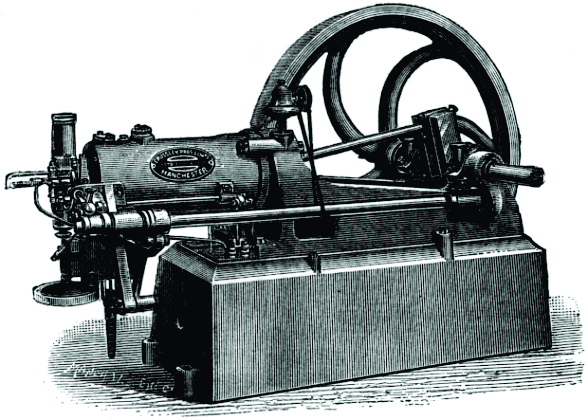
Nikolaus Otto and the Four-Stroke Engine – In 1876, Nikolaus Otto developed the four-stroke internal combustion engine, which remains the foundation of most petrol engines today.
The four strokes are elegantly simple:
- Intake – fuel and air enter the cylinder
- Compression – the piston compresses the mixture
- Power – a spark ignites the mixture, pushing the piston down
- Exhaust – burned gases are expelled
This design dramatically improved efficiency and reliability.
The Otto cycle, as it became known, allowed engines to run smoothly and deliver consistent power. Soon, engineers across Europe began refining and adapting the concept. Among those engineers were two men whose names would become synonymous with automobiles.
Daimler, Benz, and the Birth of the Car – During the 1880s, German engineers Gottlieb Daimler and Karl Benz independently developed small, high-speed petrol engines that could power vehicles.
Karl Benz built what is widely considered the first true automobile in 1885: a three-wheeled motorcar powered by a petrol engine. It was slow, loud, and looked vaguely like a mechanical tricycle – but it worked. His wife, Bertha Benz, deserves enormous credit for proving its practicality. In 1888 she secretly took the vehicle on the first long-distance automobile journey, driving roughly 106 kilometers. Along the way she solved mechanical problems, invented the first brake lining, and effectively demonstrated that motorcars could be used for real transportation rather than just engineering experiments. Meanwhile, Daimler was developing lightweight engines suitable for vehicles, including motorcycles and cars. These innovations laid the foundation for the modern automotive industry. By the early 20th century, cars were becoming increasingly common – especially after Henry Ford introduced assembly-line production with the Model T in 1908. Mass production dramatically lowered prices and made automobiles accessible to ordinary people. The petrol engine had arrived. But petrol was not the only option. - Rudolf Diesel and the Engine That Refused to Spark – While petrol engines used spark plugs to ignite fuel, Rudolf Diesel had a different idea. Diesel believed that a far more efficient engine could be built by compressing air so tightly that fuel injected into the cylinder would ignite spontaneously, without a spark. In 1897 he successfully demonstrated the diesel engine. Diesel engines operate at much higher compression ratios than petrol engines, making them more efficient and better suited for heavy-duty applications. They also produce greater torque, which is ideal for trucks, ships, locomotives, and industrial machinery.
Initially, diesel engines were large and heavy. But their efficiency and reliability made them indispensable. Today, diesel engines power cargo ships, freight trains, construction equipment, and long-haul trucks – the backbone of global trade. In other words, if you have ever purchased anything that traveled more than a few hundred kilometers to reach you, there is a good chance a diesel engine was involved somewhere along the journey.
Engines and Human Progress – It’s difficult to overstate the impact engines have had on human civilization. Steam engines powered the Industrial Revolution, enabling mass manufacturing and transforming agricultural societies into industrial ones. Internal combustion engines made personal transportation possible, reshaping cities, economies, and daily life. Diesel engines enabled the global logistics networks that support modern trade. Engines also changed warfare, exploration, and agriculture. Tractors replaced horses. Airplanes shrank the planet.
Ships became faster and more reliable. And along the way, engineers continued refining engines to become more efficient, more powerful, and – ideally – less prone to catastrophic mechanical failure. Though if you have ever owned an older car, you will know that “less prone” does not mean “immune.”
The Modern Engine – Modern petrol and diesel engines are marvels of precision engineering. Computer-controlled fuel injection systems ensure optimal combustion. Turbochargers boost power by forcing additional air into the cylinders. Advanced materials allow engines to operate under extreme temperatures and pressures.
A modern car engine contains dozens of sensors, multiple computers, and engineering tolerances measured in fractions of a millimeter.
Compared to early steam engines, which required a dedicated engineer armed with a shovel and a healthy respect for exploding boilers, modern engines are astonishingly reliable. You can turn a key – or press a button – and expect the engine to start instantly, regardless of whether it’s a freezing winter morning or a blazing summer afternoon. This reliability is so common that most people rarely think about the incredible complexity sitting beneath their car’s hood. Until, of course, the check-engine light appears. At that moment, the long history of engines suddenly becomes very personal, and still seems to confuse blondes around the world.
The Future of Engines – Today, engines face a new challenge. Environmental concerns and climate change are pushing the world toward cleaner energy sources. Electric vehicles are becoming increasingly common, and some countries plan to phase out internal combustion engines entirely over the coming decades. Whether this transition happens quickly or slowly remains to be seen.
But even if electric motors eventually replace petrol and diesel engines in many applications, the legacy of the internal combustion engine will remain enormous. It shaped the modern world in ways few inventions ever have. From the steam engines of the 18th century to the precision engines of today, humanity’s ability to harness energy and convert it into motion has driven centuries of progress. And it all started with a simple idea: What if boiling water could move a machine?
So, basically, Engines are, at their core, machines that transform energy into motion. That might sound simple, but it represents one of humanity’s greatest technological achievements.
From Thomas Newcomen’s mine pumps to James Watt’s improved steam engines…
From Nikolaus Otto’s four-stroke cycle to Karl Benz’s first motorcar…
From Rudolf Diesel’s high-compression engine to the sophisticated machines in modern vehicles… Each step in the evolution of engines reflects humanity’s relentless pursuit of efficiency, power, and convenience. Engines allowed us to mine deeper, travel farther, produce more, and connect the world in ways our ancestors could scarcely imagine.
They also made traffic jams possible, which proves that every great invention has its downsides.
Still, the engine remains one of the defining technologies of modern civilization. Without it, the world would look very different – and far quieter. Though perhaps not necessarily better.
After all, progress has always been powered by a mixture of ambition, ingenuity, and the occasional controlled explosion.