
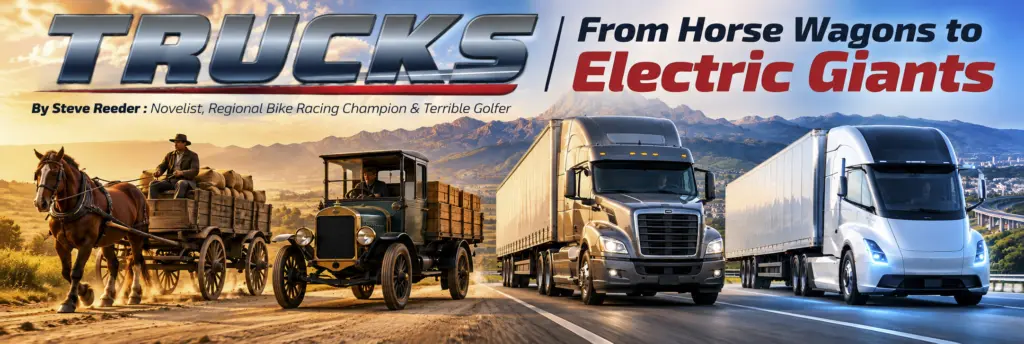
By Steve Reeder – Novelist, Regional Bike Racing Champion & Terrible Golfer
Few machines look as comfortable being enormous as a truck. A sports car looks fast even when parked, while a tractor looks as though it has never met a flower. A truck, meanwhile, simply looks as though it has somewhere important to be. And usually, it does.
Modern heavy trucks haul tons of cargo across continents, climb mountains, brake with astonishing precision and operate for hundreds of thousands of kilometres. Increasingly, computers monitor almost everything happening between their tyres. Yet the truck began rather more modestly. It began with a wagon.
Before the Truck, There Was the Wagon
For thousands of years, moving heavy goods meant finding something strong enough to carry them and something powerful enough to pull it, usually a horse or an ox. The Industrial Revolution changed everything. Factories produced goods in unprecedented quantities, mines supplied coal and minerals, and railways spread rapidly. But railways couldn’t go everywhere. Goods still needed transporting between factories, stations, warehouses and customers.
The world needed something that could do the work of a horse wagon without requiring the horse. Enter the internal-combustion engine. And, eventually, the truck.
The First Trucks Were Basically Wagons Having an Identity Crisis
Gottlieb Daimler is generally credited with building the world’s first motorised truck in 1896. His vehicle carried approximately 1.5 tons, developed just four horsepower and reached around 12 km/h. Four horsepower! Today, that wouldn’t get a truck driver out of the depot. Daimler replaced the horse with an engine, initially mounted at the rear. By 1898, the engine had moved beneath the driver’s seat and eventually to the front, establishing a layout that would define trucks for decades. Engineers soon discovered that a truck wasn’t simply a car with a bigger engine. Its frame, axles, suspension, brakes, gearbox and tyres all needed to withstand enormous loads. The engine had to produce tremendous pulling power without falling apart.
Underneath a truck’s seemingly simple exterior lies a carefully balanced combination of mechanical engineering, electronics and thermodynamics. Then someone attaches a trailer and asks it to climb the Outeniqua Pass!
Why Diesel Won
Petrol engines arrived first, but diesel eventually became the natural choice for heavy transport. Benz introduced a diesel engine in a production truck in 1923, and its popularity grew rapidly. Why? Because trucks don’t care about winning drag races. They care about torque.
Torque is the turning force that makes something rotate. Think of opening a door: pushing at the handle creates more turning force than pushing equally hard next to the hinges. In a truck, torque helps the engine pull a heavy load away from a standstill.
Diesel engines produce substantial torque at relatively low engine speeds and have historically offered excellent fuel economy and durability. For a trucking company operating hundreds of vehicles, even small fuel savings can make a substantial financial difference.
Diesel became the workhorse of long-distance road transport, and engineers spent the next century making it extraordinarily good at the job.
The Modern Truck Is a Computer With an Engine Attached
Open the bonnet of a modern heavy truck and you’ll find technology that would leave the engineers of 1923 wondering whether humanity had become slightly unhinged. Turbocharging, electronically controlled fuel injection, sophisticated combustion management and exhaust-gas treatment have transformed diesel engines. Sensors constantly monitor fuel delivery, pressure, temperatures, engine load and transmission performance. Increasingly, predictive software helps determine what the vehicle should do next. The transmission must then transfer that power through gears, shafts and differentials while the driver asks the vehicle to move a building.
Modern automated manual transmissions select gears automatically, balancing engine speed, load, road gradient and fuel economy. The truck can anticipate a hill, adjust its gears and communicate with its engine and braking systems.
And with artificial intelligence advancing, it’s only a matter of time before the truck revolts and fires the driver!
Axles, Suspension and Brakes: Built for Serious Work
Heavy-truck axles must transmit enormous torque while supporting tremendous weight. Some use planetary reduction systems at the wheels to multiply torque and reduce stress on drivetrain components. Remarkably, Daimler’s original 1896 truck already used a gearing arrangement that anticipated principles still found in heavy-duty construction trucks today.
Suspension systems face another challenge: supporting huge loads, absorbing bumps, maintaining tyre contact and keeping the vehicle stable, whether empty or fully loaded. Modern trucks combine leaf springs, shock absorbers and air suspension. Air suspension allows ride height to be managed more precisely, helping protect both the vehicle and its cargo. Medical equipment appreciates this. Gravel, generally speaking, doesn’t complain.
Then comes stopping. Getting a 40-ton truck moving is impressive. Stopping it is arguably more impressive. Heavy trucks use powerful air brakes, engine braking and retarders to control their speed. These additional braking systems are particularly important on long descents, reducing reliance on conventional wheel brakes.
Gravity is wonderfully consistent. Point a heavily loaded truck downhill and it will happily accelerate regardless of your enthusiasm for the brake pedal.
Modern electronics help manage these enormous forces safely.
The Truck Becomes Intelligent
Today’s trucks can monitor tyre pressure, detect wheel slip, manage braking and control engine output. They can warn drivers about lane departures, detect vehicles in blind spots and assist with emergency braking. Cameras, radar and other sensors increasingly help trucks understand their surroundings. The truck has evolved from a mechanical beast into a rolling computer network. Aerodynamics matters, too. Despite their brick-like appearance, modern trucks feature carefully designed cabs, roof fairings and side deflectors to reduce air resistance. Over hundreds of thousands of kilometres, even small improvements in fuel consumption deliver meaningful savings. Better tyres, transmissions, aerodynamics and route planning all contribute to efficiency.
The future isn’t simply about replacing the engine. It’s about improving the entire vehicle.
Electric Trucks Turn the Engineering Upside Down
Electric commercial vehicles existed long before modern battery-powered cars became fashionable. Their biggest limitation wasn’t the electric motor but energy storage. Liquid fuel stores enormous amounts of usable energy in a relatively small package. Historically, batteries couldn’t compete, making diesel difficult to beat in long-distance transport. But battery technology has advanced considerably, and electric trucks are becoming increasingly practical. Electric motors deliver substantial torque from low speeds, have relatively few moving parts and don’t require a conventional multi-speed gearbox in the same way diesel engines do. They also produce no tailpipe exhaust.
Regenerative braking provides another advantage. When an electric truck slows down, its motors can act as generators, converting some kinetic energy back into electricity. A heavy truck descending a hill has enormous energy to manage. Regenerative braking allows some of that energy to return to the battery rather than being lost entirely as heat.
The truck effectively recharges itself whenever it slows down. Not completely, of course. Physics remains annoyingly unwilling to provide free energy!
Batteries Are the Great Compromise
The biggest challenge remains the battery. Long-distance electric trucks need substantial energy storage, but batteries are heavy. A bigger battery helps carry a heavy load, yet the battery itself adds weight and requires more energy to transport. Welcome to engineering!
Battery technology and charging infrastructure continue to improve. Volvo’s electric heavy-truck programme includes vehicles intended for regional and long-haul applications, with configurations offering ranges of up to approximately 700 km.
Electric trucks also don’t need to replicate diesel designs exactly. Motors can be positioned differently, battery packs distributed throughout the chassis and power electronics integrated into axles.
Manufacturers are developing integrated electric axles that combine motors, electronics and transmission components into compact packages. Refrigeration equipment can also potentially draw electricity directly rather than relying on a separate diesel engine.
The future truck may not be a diesel truck with its engine removed. It could be an entirely different machine.
Diesel Isn’t Going Away Tomorrow
The death of the diesel truck has been announced several times, but diesel appears to have ignored the announcements.
Truck fleets are businesses. A truck isn’t purchased because it’s fashionable; it’s purchased because it makes money moving something from A to B.
If an electric truck can do the job, recharge conveniently, carry the required payload and reduce operating costs, fleet operators will take notice.
However, routes requiring enormous range, remote travel or particularly heavy loads may continue favouring diesel, especially where charging infrastructure is limited. Battery-electric vehicles will increasingly serve suitable applications, while hydrogen and renewable fuels may have roles in certain heavy-duty operations.
The trucking industry is practical, not sentimental. If a technology works, truckers will use it. If it doesn’t, they’ll quite reasonably ask, “Can it pull this?”
From Wagon to Rolling Computer
Imagine a truck that knows its route before leaving the depot. It understands the gradients, traffic, weather, charging locations and weight of its load. It adjusts its speed, recovers energy on descents, predicts maintenance requirements and assists the driver. Eventually, perhaps, it will drive itself. Some of these capabilities already exist. The remaining question is how far autonomous driving will go. Because there’s one thing engineers have never completely solved: human beings.
The extraordinary thing about truck history is how little has changed at its heart. The purpose remains simple: take something heavy, move it somewhere else, do it safely and economically, and then do it again tomorrow.
The horse disappeared, and the wooden wagon became a steel chassis. Diesel transformed heavy transport, while computers, cameras, radar and sensors revolutionised the driving experience. Now electric motors and batteries are challenging the diesel engine. Yet the truck remains what it has always been: a machine designed to carry the world on its back.
From Daimler’s four-horsepower truck of 1896 to today’s enormous articulated combinations, progress has been staggering. Perhaps the greatest achievement isn’t the size or power of modern trucks, but our ability to make something so enormous behave with such precision. Tomorrow’s truck may accomplish much of today’s work without burning a drop of diesel. The horse wagon has certainly come a long way. Although somewhere, there’s probably still a horse looking at a 700-kilometre electric truck and thinking: “Told you people would eventually overcomplicate it.”