By Steve Reeder : Novelist, Regional Bike Racing Champion and terrible golfer
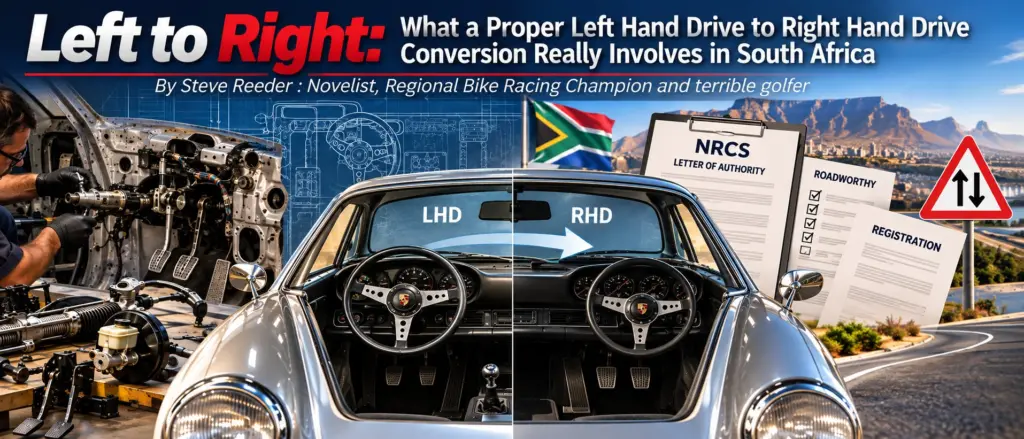
So, you have decided to change your Left-Hand Drive (LHD) to a Right-Hand Drive (RHD)? This might prove more complicated than you think.
Moving the steering wheel is the easy part. Making the entire car work properly afterwards is where things become interesting.
There is something rather seductive about importing an interesting car from America or Europe. Perhaps a classic Mustang, Porsche, Corvette, old Mercedes-Benz or Jaguar. The price may be attractive, the car exceptionally original, and the prospect of owning something unusual difficult to resist. But then reality intervenes. South Africa is a left-hand-traffic country, and suddenly that beautifully preserved LHD car presents another challenge: what exactly is involved in converting it? The popular answer is usually: “Move the steering wheel.” Ah yes, if only it were that simple! A proper conversion can involve the steering, pedals, brakes, firewall, dashboard, electrical systems, heating and ventilation, wipers, headlights, airbags and electronic safety systems. The steering wheel is merely what the owner sees. The engineering is underneath.
More Than Moving the Steering Wheel
A vehicle is designed as an integrated system. Steering columns, racks, pedals, brake boosters, master cylinders and wiring are arranged around the driver’s position. A proper conversion must recreate the factory RHD arrangement rather than simply relocate the steering wheel. Two vehicles may look identical inside, yet be worlds apart underneath. One may use factory RHD components and carefully engineered structures. The other may have had its steering column extended, holes cut in the firewall and pedals moved until everything appeared to fit. From ten metres away, they may look identical. Engineering-wise, they are not.
Steering, Pedals and Braking
Depending on the vehicle, conversion may require a different steering rack, steering box, column, intermediate shaft, universal joints or mounting points. The system must retain appropriate geometry, strength, rigidity and predictable handling. Simply cutting the original steering column, extending it and welding it back together is not an acceptable engineering solution. Modern steering columns may also form part of the vehicle’s crash-safety design, which must be preserved. Factory RHD components are preferable where available. Bespoke components should be properly engineered for the particular vehicle. The pedals are equally important. A conversion may require repositioning the brake, clutch and accelerator pedals, pedal box, master cylinder, brake booster and associated linkages. Braking performance depends not only on discs, drums and calipers, but also on the relationship between the pedal, pedal ratio, master cylinder and booster. Moving a pedal without considering the complete system can alter pedal effort and travel.
A 1960s sports car and a 2020s luxury SUV may both technically be LHD-to-RHD conversions, but the engineering challenges are vastly different.
The Firewall Is More Important Than the Dashboard
The firewall separates the engine compartment from the passenger compartment and can form part of the vehicle’s structural architecture. It accommodates many conversion components, including steering columns, brake boosters, master cylinders, wiring and heating systems.
Structural modifications may therefore be necessary. Poorly reinforced mounting points, incorrectly positioned holes or inadequate welding can affect the vehicle’s integrity. Strength, support, sealing and fire protection must all be maintained. Modern dashboards also contain instrument clusters, infotainment systems, airbags, cameras, sensors and electronic control modules. Simply moving visible controls does not guarantee that the electronic systems will continue working correctly.
Airbags, Electronics and Visibility
Modern steering wheels can contain driver’s airbags, while steering columns may incorporate steering-angle sensors. ABS, electronic stability control and driver-assistance systems rely on information from multiple sensors. On vehicles equipped with lane-keeping assistance, adaptive cruise control, cameras and radar, the challenge becomes even greater. The question should not be: “Can we fit the steering wheel on the other side?” It should be: “Can the vehicle’s safety systems continue functioning as the manufacturer intended?” Windscreen wipers are another overlooked detail. Their linkage determines the sweep pattern, which manufacturers generally optimise for the driver’s position. Following conversion, the driver must have an appropriate clear area. Headlights are equally important. They are designed around the side of the road on which a vehicle operates. South Africa drives on the left, and changing the steering position does not change the headlight beam pattern.
Suspension components may not always need changing, but steering rack position, track rods and suspension geometry must work together correctly. Incorrect geometry can cause abnormal tyre wear, poor stability, unpredictable steering and undesirable handling. A proper conversion should therefore include wheel alignment and, where appropriate, verification of steering geometry.
Roadworthy Does Not Mean Engineering Approval
One important misconception is that if a car drives perfectly well, everything must be in order. The Western Cape Government describes the roadworthy test as a safety examination rather than a comprehensive technical examination. It includes checks of identification, electrical systems, brakes, wheels and tyres, suspension, steering, engine, exhaust, transmission and vehicle dimensions. A Certificate of Roadworthiness does not mean every aspect of an LHD-to-RHD conversion has been professionally engineered and approved. It means the vehicle has passed the applicable roadworthy examination. The National Regulator for Compulsory Specifications (NRCS) has a separate role. South African Government guidance states that anyone intending to import or register a built, manufactured or modified vehicle must obtain the relevant Letter of Authority (LOA) from the NRCS where applicable. The NRCS states that an LOA is required for imported new or used vehicles and vehicles built or modified by individuals or organisations not registered as manufacturers, importers or builders. It may also be required when a registered manufacturer, importer or builder modifies a vehicle to an unapproved design or model. Applications can require vehicle details, engine and chassis numbers, roadworthy and police-clearance information, modification details and the source of components, particularly safety-critical components. In other words, the history of the work matters.
Importing and Registering Are Separate Processes
Importation may involve the International Trade Administration Commission (ITAC), while vehicle conformity and certain modification approvals involve the NRCS. Registration takes place through the relevant provincial registering authority, with roadworthiness testing conducted at an authorised testing station. Police clearance and identification may also form part of the process. Modified vehicle registration requirements can include identification, proof of address, an affidavit describing the parts used and work performed, police clearance, a weighbridge certificate, proof of ownership, a roadworthy certificate and an LOA where applicable. A manufacturer’s certificate or previous registration certificate may also be required.
The message is straightforward: Do not leave the paperwork until the end. Establish the documentation requirements before starting the conversion. It is considerably easier to design the work around regulatory requirements than to discover afterwards that important information is missing.
Documentation, Value and Insurance
If I were buying an expensive converted classic, I would want considerably more than a receipt stating “LHD converted to RHD”. The conversion file should ideally include:
– Photographs before, during and after conversion.
– Details and sources of steering, braking and RHD donor components.
– Engineering drawings and invoices, where applicable.
– Details of structural work.
– Wheel-alignment results.
– Roadworthy, NRCS and registration documentation.
– Police-clearance and weighbridge documentation, where applicable.
– Written insurance confirmation.
Why? Because the next owner will want to know what happened to the car. Ten years later, the person who performed the conversion may no longer be available to explain it. Documentation turns an undocumented modification into part of the vehicle’s provenance. Insurance should also be discussed before the conversion begins. Owners should disclose proposed modifications and obtain written confirmation of how the completed vehicle will be insured. This is particularly important with classic and collector vehicles. There is a difference between conventional market-value insurance and an agreed-value arrangement. Do not assume the insurer automatically understands the value of a rare imported classic.
Originality can also affect collector interest. An original LHD Ferrari, Porsche or Jaguar may have a different collector profile from an otherwise identical converted vehicle. That does not mean every conversion destroys value. Quality and documentation matter.
Reversibility is another consideration. Where possible, retain original LHD components. Throwing everything into a skip because “we don’t need that anymore” may be convenient at the time. Five years later, it could be an expensive mistake.
Questions Every Buyer Should Ask Before buying an already-converted vehicle or commissioning a conversion, ask:
– Has this exact model been converted before?
– Which factory RHD components are being used?
– What needs to be fabricated?
– Will structural components be modified, and why?
– What happens to the braking system?
– What happens to the steering geometry?
– What happens to airbags and electronic safety systems?
– What documentation will be supplied?
– What will be required for NRCS approval and registration?
– Will the insurer accept the completed vehicle in writing?
Once complete, steering, brakes, wheel alignment, electrical systems, airbags, wipers and lights should all be checked where applicable. The vehicle must undergo the applicable roadworthy process, and required NRCS and registration documentation must be completed.
There are essentially two types of conversion: a cosmetic conversion, where everything is made to look right, and an engineering conversion, where all affected systems are considered as an integrated whole. The difference is not necessarily visible in photographs. It can only be established by examining the work and documentation. There is nothing inherently wrong with converting an LHD vehicle to RHD. For certain imported classics and specialist vehicles, it can be a perfectly sensible way of making an otherwise desirable vehicle practical for South African roads. But the phrase “LHD-to-RHD conversion” makes the process sound deceptively simple. It isn’t.
Don’t ask only: “Can you move the steering wheel?” Ask instead: “Can you engineer the entire vehicle correctly, document what has been done, satisfy the regulatory requirements and leave me with a car I can legally register, insure and confidently hand to the next owner?”
A properly converted vehicle should not merely look like a right-hand-drive car. It should behave like one, comply like one, and have the paperwork to prove what has been done.
Because when the car is sitting in the driveway, the steering wheel may be the first thing you notice. But when something goes wrong, it is everything you cannot see that matters.