
By Steve Reeder: Novelist, Regional Bike Racing Champion and terrible golfer
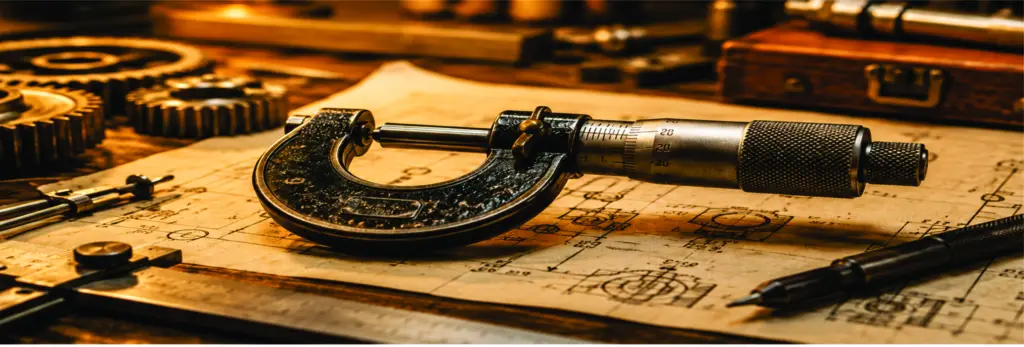
When I was a child, my father owned what seemed to me to be a fascinating collection of exotic tools. He was a qualified watchmaker, and his workshop was filled with tiny screwdrivers, brass gears, half-dismantled clocks and springs that seemed determined to launch themselves into orbit whenever the wrong screw was loosened. One tool fascinated me more than any other: the micrometer. Naturally, I eventually decided to “play” with it. My father rescued it before I could permanently alter the standards of precision engineering with sticky fingers and youthful enthusiasm. Rather than simply taking it away, he explained what it was, how it worked and, most importantly, why it mattered. That conversation stayed with me.
He explained that modern industry depends on the ability to manufacture parts accurately and repeatedly. Making one nut or bolt is relatively easy. Blacksmiths had done that for centuries. The real achievement is producing thousands of identical nuts and bolts so that any one of them will fit any machine built anywhere in the country. Without precision measurement, engineering descends into chaos. Imagine every vehicle repair requiring a craftsman to hand-make every replacement bolt. Imagine every railway repair depending on an artisan named Jannie filing metal until it “looked about right.” Civilisation would grind to a halt remarkably quickly.
The micrometer helped prevent exactly that. History often celebrates dramatic inventions such as the steam engine, electricity or the computer, but some of the most influential innovations are small, quiet and largely unnoticed. The micrometer belongs firmly in that category. It never roared like a locomotive or dazzled like electric light, yet without precision measurement and the culture of exact engineering it encouraged, much of the Industrial Revolution might never have unfolded as it did. The micrometer transformed engineering from an art based largely on craftsmanship into a science built on measurement, repeatability and standardisation.
Engineering Before Precision – Before the Industrial Revolution, manufacturing relied heavily on individual skill. Blacksmiths, gunsmiths, clockmakers and machinists built components largely by hand, filing, scraping and adjusting each piece until it fitted. The problem was that parts made for one machine rarely fitted another. An eighteenth-century musket, for example, was effectively unique. While that may sound romantic today, it was a serious problem when something broke in battle. Replacement parts usually had to be custom-made for that specific weapon. The obstacle was measurement. Engineers had rulers, calipers and gauges, but they lacked the accuracy needed to manufacture interchangeable parts. Tiny differences in dimensions caused steam engines to leak, machine tools to wear unevenly and weapons to perform inconsistently. Industry was becoming more sophisticated, but measurement had not yet caught up.
The Earliest Micrometers
The principle behind the micrometer dates back to the seventeenth century. English astronomer William Gascoigne developed a micrometric screw while working with telescopes during the 1630s. He discovered that an accurately threaded screw could convert tiny rotational movements into precise linear measurements, allowing astronomers to measure minute distances between stars. Although intended for astronomy rather than engineering, Gascoigne had introduced the fundamental principle behind the modern micrometer. For more than a century, however, manufacturing remained limited by the quality of machine tools themselves. Engineers understood the importance of precision but lacked machines capable of producing it consistently.
Henry Maudslay and Precision Engineering
One of the most influential figures in industrial history was English engineer Henry Maudslay.Although less famous than James Watt or George Stephenson, Maudslay’s contribution to manufacturing was arguably just as important. He recognised that accurate machines first required accurate machine tools. Around 1800 he developed the screw-cutting lathe, enabling highly consistent and standardised screw threads to be produced for the first time. Modern audiences rarely appreciate standardised screw threads, largely because they have never experienced the frustration of a bolt that almost fits. Before Maudslay, screws varied enormously in size and pitch. Machinery built in different workshops often used completely incompatible fasteners. His lathe changed that. Maudslay also developed one of the earliest practical engineering measuring systems, nicknamed “The Lord Chancellor,” which became the workshop’s ultimate authority on accuracy.
Among the young engineers who trained under him was Joseph Whitworth.
Joseph Whitworth and the Culture of Exactness
Born in 1803, Sir Joseph Whitworth became one of Victorian Britain’s greatest engineers. Building upon Maudslay’s work, Whitworth elevated precision engineering to an entirely new level. At a time when measurements often varied within the same factory, he insisted that engineering should be governed by exact standards rather than judgement or guesswork. He perfected surface scraping techniques that produced exceptionally flat reference surfaces, allowing machine tools to operate with unprecedented accuracy. Whitworth also developed measuring equipment capable of detecting differences as small as one-millionth of an inch—an astonishing achievement in the nineteenth century. More importantly, he created a philosophy in which precision became the foundation of manufacturing. Once measurements could be trusted, machines could reliably produce interchangeable parts. Factories no longer depended entirely on the skills of individual craftsmen. Production could increase dramatically while maintaining consistent quality. This became one of the foundations of modern mass manufacturing.
Could the Industrial Revolution Have Happened Without the Micrometer?
The Industrial Revolution was about far more than steam power and coal.
It was about repeatability. Factories succeeded because they could manufacture large numbers of identical components efficiently. Without precision measurement, interchangeable parts are impossible. Without interchangeable parts, mass production becomes slow, expensive and unreliable. Steam engines provide an excellent example. Early engines leaked steam because cylinders and pistons could not be machined accurately enough. Even slight imperfections wasted enormous amounts of power. James Watt’s improvements depended heavily on advances in precision machining, particularly John Wilkinson’s cylinder-boring machine, which produced cylinders accurate enough for Watt’s designs to operate efficiently. The micrometer and related measuring tools allowed engineers to monitor tolerances, wear and clearances with remarkable precision, resulting in machinery that was more powerful, reliable and easier to maintain. Railways, textile mills, steamships and factories all depended upon accurately manufactured components. Without precision measurement, industrialisation would almost certainly have developed far more slowly. The micrometer did not simply improve the Industrial Revolution- it helped make it possible.
Standardisation: The Invisible Revolution
Whitworth understood that precision alone was not enough. Industry also required standardisation. In 1841 he introduced the British Standard Whitworth screw thread system, the first nationally adopted engineering standard for screw threads. Before then, manufacturers often produced completely different thread sizes and angles. Machinery from different factories could be incompatible.
Whitworth’s system changed that. Railway companies rapidly adopted the new standard because maintenance became simpler and manufacturing became more efficient. This may sound like a minor administrative achievement, but standardisation is one of civilisation’s hidden triumphs. Imagine a world where every vehicle required unique bolts, every household light bulb had a different fitting and every machine demanded custom-made replacement parts. Modern industry simply could not function. The micrometer made accurate measurement possible. Standardisation made large-scale manufacturing practical. Together they transformed the industrial world.
The Connection Between Precision Engineering and Firearms
Firearms have historically driven advances in manufacturing because they demand exceptional consistency and reliability. Tiny variations in dimensions can dramatically affect performance and accuracy. Following weaknesses exposed during the Crimean War, the British government asked Whitworth to investigate improvements to military rifles. Rather than approaching the task as a traditional gunsmith, he analysed barrel dimensions, rifling geometry, projectile design and manufacturing tolerances scientifically. The result was the famous Whitworth rifle.
Contrary to popular belief, Whitworth did not invent rifling. Spiral grooves inside gun barrels had existed since at least the sixteenth century. His achievement was applying precision engineering to firearm design. Instead of conventional rifling, Whitworth designed a hexagonal polygonal bore matched to a similarly shaped projectile. The result was extraordinary long-range accuracy. The rifle significantly outperformed many competing military rifles during official trials and later earned a formidable reputation during the American Civil War, where Confederate sharpshooters used it with devastating effect. Although Whitworth did not invent rifling, he demonstrated how scientific precision could transform weapons technology. The same engineering principles that created interchangeable machine parts also produced more accurate firearms. History repeatedly reminds us that humanity has an extraordinary talent for applying every technological breakthrough to warfare almost as quickly as to civilisation.
Precision and the Modern World
The legacy of the micrometer extends far beyond the nineteenth century. Modern civilisation depends upon engineering tolerances that earlier generations would have considered impossible. Automobile engines rely on precisely machined pistons and bearings. Aircraft turbines operate at enormous speeds while maintaining microscopic clearances.
Computer chips contain structures measured in nanometres. All of this can trace its heritage back to the culture of precision established by engineers such as Maudslay and Whitworth. Precision measurement also transformed quality control. Instead of discovering faults only after machines failed, manufacturers could detect problems during production itself, improving reliability while reducing waste and cost. Today’s economy depends less on brute force than on extraordinary precision. The ability to manufacture millions of identical components consistently and economically defines modern industrial society.
The Human Side of Precision
There is also a philosophical lesson in the story. Before industrialisation, manufacturing relied heavily on intuition and individual craftsmanship. Precision engineering introduced a different way of thinking. Measurement became the ultimate authority. Whitworth and his contemporaries believed engineering problems could be solved through careful observation, accurate measurement and repeatable processes. That mindset spread far beyond engineering into science, manufacturing, management and modern industry itself. Factories became systems rather than collections of craftsmen. The micrometer symbolised humanity’s growing ability to control matter with astonishing accuracy.
Why the Micrometer Matters More Than Most People Realize
The micrometer appears to be an ordinary workshop tool. It rarely receives the admiration given to rockets, artificial intelligence or dramatic engineering achievements. Yet it remains one of the great enabling technologies of modern civilisation. Many inventions become famous because they are visible. People admire locomotives, skyscrapers and aircraft because they are spectacular. The micrometer is different. It quietly made those achievements possible. Without accurate measurement there can be no reliable machine tools. Without reliable machine tools there can be no interchangeable parts. Without interchangeable parts there can be no efficient mass production. The modern industrial world rests upon that chain of precision. Although the micrometer’s origins lie in seventeenth-century astronomy, it reached its true significance during the Industrial Revolution through the work of Henry Maudslay and Sir Joseph Whitworth. Together they demonstrated that the future of engineering depended not simply on power, but on accuracy. Whitworth improved measuring systems, standardised screw threads and established a culture of exactness that continues to define engineering today. He also showed how precision manufacturing could revolutionise firearm design, although his greatest legacy lies not in weaponry but in the broader transformation of manufacturing itself.
Ultimately, the story of the micrometer is the story of civilization learning to master precision. The Industrial Revolution was not driven solely by steam and iron. It was driven by humanity’s growing ability to measure, standardize, and reproduce the physical world with microscopic accuracy.
That quiet revolution began with tools like the micrometer.
And from that tiny instrument.