
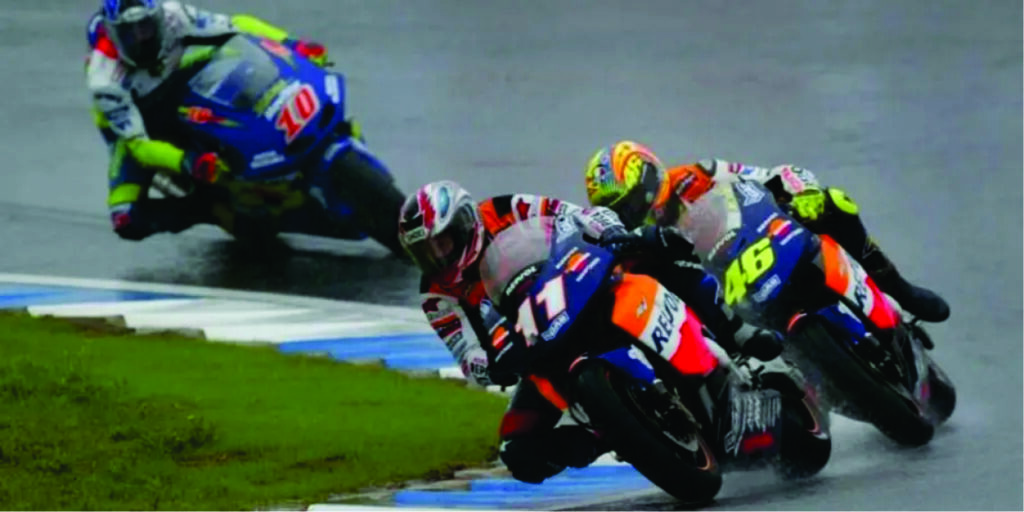
There was a time when Grand Prix motorcycle racing smelled like danger, burnt Castrol R, and mild insanity. I still get excited at the smell of 2-stroke oil! If you were close enough to the track in the 1990s, your eyes watered, your ears rang for days, and you went home convinced that human beings had no business travelling that fast on two wheels held together by optimism and aluminium welds – and sometimes duct tape when all else failed. That was the 500cc two-stroke era: loud, violent, gloriously unfiltered – and, whether we like it or not, everything that has happened since has been an attempt to civilise it.
The 500s were not friendly motorcycles. They didn’t reward smoothness so much as bravery, aggression, and an intimate relationship with fear. Powerbands arrived like pub brawls – suddenly and without apology. Riders talked about “backing it in” because there was no other way to get the things stopped. Electronics were rudimentary, tyres were often only slightly better than what we had on our Sunday Breakfast Run machinery, and highsides were less accidents than career events. Kevin Schwantz once said riding a 500 was like trying to tame a wild animal that actively wanted to kill you. He was not exaggerating. I know – I tried one at Brands Hatch!
By the late 1990s, however, reality intruded. Manufacturers were spending vast sums developing engines that had little relevance to road bikes. Environmental pressures were growing. TV broadcasters wanted cleaner racing and more reliable finishes. And, crucially, Honda had built a four-stroke V5 that could embarrass the two-strokes while wearing a polite smile. The writing was on the wall, even if it was scrawled in blue smoke and grease.
So in 2002, MotoGP was born. The 500cc two-strokes were ushered toward the exit, and four-stroke engines up to 990cc were invited in. Officially, this was progress. Unofficially, it was the beginning of a long and complicated negotiation between engineers, accountants, regulators, and the laws of physics. The bikes were heavier, more powerful, and easier to ride – at least relatively speaking. Riders adapted. Lap times fell. Fans argued. The sport survived.
The next two decades were defined by refinement and escalation. Engine capacities were trimmed to 800cc in 2007 in the name of safety, then expanded again to 1000cc in 2012 because, well… racing. Electronics became smarter than some of the riders’ early-career managers. Traction control, launch control, anti-wheelie, seamless gearboxes – the bikes evolved from mechanical monsters into rolling data centres with fairings.
And yet, something curious happened along the way. As the machines became more sophisticated, the racing sometimes became less so. Aerodynamics sprouted like experimental barnacles. Ride-height devices appeared, allowing bikes to squat, stretch, and pogo their way down straights with all the grace of a grasshopper on too much coffee. Costs ballooned. Independent teams struggled. And the gap between those with factory backing and those without grew wider than a Kyalami gravel trap – which I used to have a close relationship with.
Which brings us neatly to the current era: the age of regulation by spreadsheet. MotoGP’s rulers have looked at the sport and decided that, for it to survive, it must be made slightly less clever. Thus, from 2027, MotoGP will downsize again – to 850cc engines, less fuel, reduced aerodynamics, and a firm ban on ride-height and holeshot devices. The goal is noble: closer racing, lower costs, and bikes that reward riders rather than PhDs. Whether it works remains to be seen, but history suggests that engineers will always find a way to colour outside the lines.
While all of this has been unfolding at the top of the pyramid, the lower classes have been on their own journey – one that mirrors the same tension between purity and pragmatism.
From 250cc Two-Strokes to Moto2 – The Middle Class Grows Up
The 250cc two-stroke class was once the thinking rider’s category. Less outright violence than the 500s, but arguably just as difficult to master. These bikes demanded precision, corner speed, and a delicate touch with a throttle that could still bite. Champions like Biaggi, Capirossi, and later Pedrosa honed their craft here, learning racecraft and mechanical sympathy before being unleashed on the big bikes.
But by the mid-2000s, the same pressures that killed the 500s were tightening their grip. Development costs were climbing, manufacturers were disappearing, and the class had become dominated by a shrinking number of factory-supported teams. The two-stroke clock was ticking.
In 2010, the 250s were replaced by Moto2 – and with them came one of the most radical shifts in Grand Prix history. Gone were bespoke factory engines. In their place arrived a single, sealed engine supplied to everyone. Initially, it was a Honda CBR600RR four-cylinder – essentially a superbike heart in a prototype body – controlled, equalised, and stripped of exotic tuning.
The philosophy was clear: stop the engine arms race and put the emphasis back on chassis design, setup, and rider skill. It worked. Almost immediately, Moto2 became fiercely competitive. Different chassis manufacturers flourished. Riders had to adapt to heavier bikes with less power delivery drama but far more physical demand. Races were close, unpredictable, and refreshingly free of factory dominance.
Then, in 2019, Moto2 took another evolutionary step. Honda stepped aside, and Triumph arrived with a purpose-built 765cc triple – derived from the Street Triple, but sharpened into something very special. Power increased. Torque arrived earlier. Lap times dropped. And Moto2 suddenly felt less like a stepping stone and more like a destination in its own right.
Crucially, Moto2 proved that standardisation didn’t have to mean dullness. With equal engines, the racing tightened. Talent rose to the surface faster. Riders learned to manage momentum, tyre wear, and aggression – skills that translated beautifully to MotoGP. In many ways, Moto2 became the most honest class in the paddock: no gimmicks, no electronic crutches, just riders wrestling big, physical bikes on the limit.
It also set a precedent – one the sport would increasingly lean on.
Moto3 and the March Toward Costs-cutting Uniformity
The original 125cc two-stroke class was, in many ways, the last refuge of chaos. Tiny bikes, enormous corner speed, and slipstream battles so tight they resembled synchronised swimming with fairings. It was cheap(ish), brutal, and brilliant. Naturally, it had to go.
In 2012, Moto3 arrived. Out went the two-strokes, in came 250cc four-stroke single-cylinders. The stated aim was to prepare riders for modern racing and reduce costs. The unstated aim was to align the junior class with environmental expectations and manufacturer marketing departments. On track, Moto3 delivered close racing, gigantic packs, and last-corner lunges that made race directors sweat. Mass pile-ups became an occupational hazard – but that’s a story for another day.
Moto3, however, also became a victim of its own success.
Development costs crept upward. Chassis wars intensified. Engine suppliers squeezed out marginal gains that cost real money. Teams spent more and more to remain competitive, while the class itself remained a stepping stone rather than a destination.
And so, inevitably, the next solution arrived – further standardisation.
Following the successful example set by Moto2 with Triumph engines, from 2028 Moto3 is set to become a one-engine class, with a single 700cc engine supplied – widely expected to be by Yamaha. Yes, 700cc. No, that is not a typo. The smallest Grand Prix class will soon have engines larger than the legendary 500s of old, albeit with far less power and significantly more restraint.
The logic is, once again, sound on paper. A single engine supplier reduces costs. Equal machinery puts the focus back on rider skill. A 700cc platform creates a smoother progression toward Moto2 and, ultimately, MotoGP. From a developmental standpoint, it makes sense. From a nostalgic standpoint, it feels faintly absurd. Those of us who raced 2-strokers . . sigh!
There is something deeply ironic about the idea that Grand Prix racing began with lightweight, temperamental, borderline psychotic two-strokes – and is now moving toward carefully regulated, centrally supplied engines designed to offend no one and surprise even fewer. We have gone from “hang on and hope” to “please refer to the technical bulletin.” I recall, a few years ago, being in the pits with my old mate Robbie Breakspear explaining to the 600 kids about ‘plug-chops’ and tasting your spark-plug to see if your jetting was right. They shook their collective heads and went to work on the laptops to change the engine mapping.
That said, this is not necessarily a bad thing. Racing has always evolved in response to the world around it. The days when manufacturers could justify unlimited spending on niche technology are gone. Sustainability matters. Safety matters. And if a one-engine Moto3 class produces closer racing, more affordable grids, and a healthier ladder for young riders, then perhaps it is a compromise worth making.
What must be guarded against, however, is the erosion of identity. Grand Prix racing has never been about perfection. It has been about excess – too much speed, too much risk, too much ambition. The danger of over-regulation is not that racing becomes slow, but that it becomes sterile.
The trick, as always, will be balance. Leave enough freedom for ingenuity without allowing costs to spiral. Reduce complexity without insulting intelligence. And remember that fans fell in love with this sport not because it was sensible, but because it was spectacular.
From blue smoke to sustainable fuel, from shrieking two-strokes to spec-sheet engines, motorcycle Grand Prix racing has travelled a long way. It is older now. Wiser, perhaps. Certainly more organised. But if it can retain even a trace of the madness that defined the 500cc era – the sense that something slightly unhinged is about to happen – then it will continue to matter.
Because at its heart, no matter how many rules are written or engines are standardised, Grand Prix racing is still about one simple, timeless idea: the fastest way to get from one corner to the next, with someone brave enough to try it.
Let’s just hope the takeover of MotoGP by Liberty Media from Dorna Sports isn’t merely another bureaucratic coup d’état.