
A slightly wry and British humorous history of MG, from their tea-scented birth to their electric rebirth. If Britain were ever to choose a national automotive spirit animal, it wouldn’t be a Range Rover (too posh), nor a Mini (too cheeky), nor even a Jaguar (too unreliable, though stylish while doing so). No, it would probably be the MG: affordable, fun, forever teetering between glorious success and catastrophic bankruptcy – in other words, quintessentially British.
The Humble Garage That Started It All
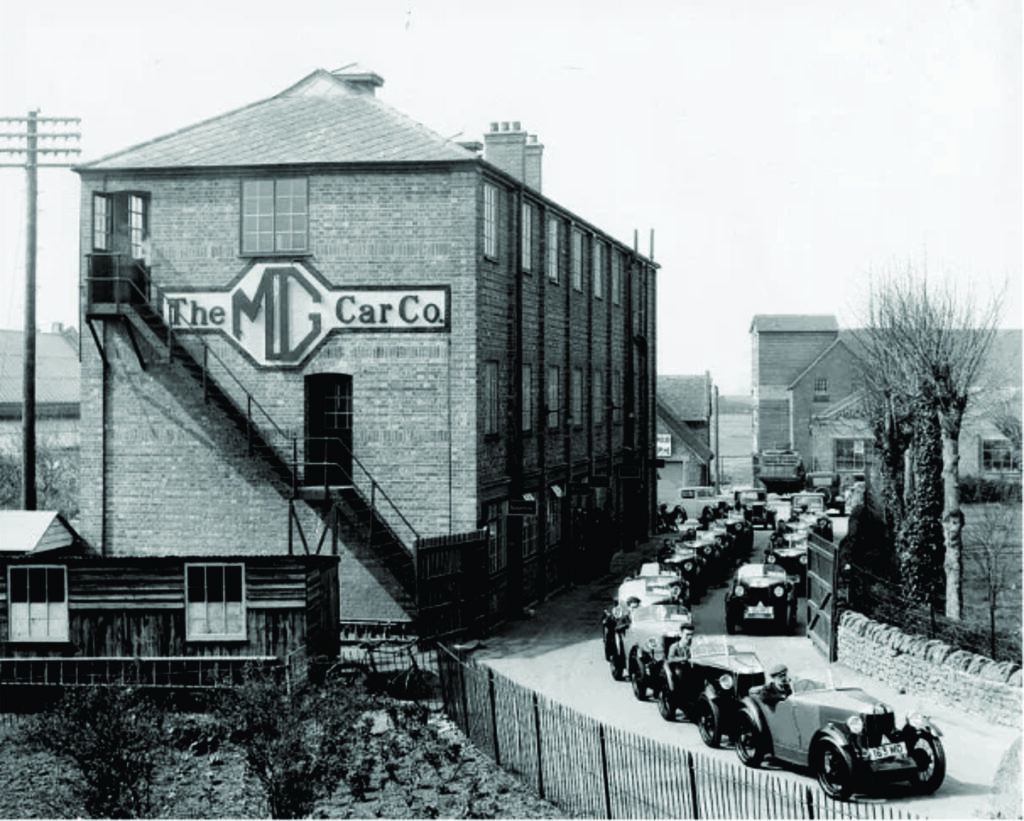
The story begins in 1924, in Oxford, at Morris Garages – hence the “MG.” William Morris, later Lord Nuffield, (Who, by the way, was an old friend of my mother!) had made his fortune selling rather ordinary cars to people who thought “motor car ownership” sounded like something one did in tweed. Into this steady but slightly boring empire strode Cecil Kimber, a man with a fondness for bow ties, sketching, and turning dull saloons into rakish sports cars.
Kimber essentially looked at a Morris Oxford and thought, what this dreary lump really needs is a diet and a saucy new body – remind me of my last girlfriend, really.
The first MGs were basically warmed-over Morrises with more curves, less weight, and a bit of attitude – like giving your accountant a leather jacket and sending him to dance lessons. People loved them.
By the late 1920s MG was churning out little two-seat roadsters that looked fast even when parked outside a pub. They weren’t just stylish either – they could actually go quite quickly, especially downhill, with a following wind, and if the driver had packed a prayer book.
Racing Into the Spotlight – Nothing says “serious car maker” like trying to kill drivers at high speed in pursuit of trophies. MG quickly cottoned on to the idea that racing wins on Sunday sold cars on Monday. In the 1930s, MGs were buzzing around race tracks and setting land speed records at Brooklands and on salt flats in the U.S.
They weren’t Ferraris, mind you, but they punched above their weight. Tiny MGs embarrassed bigger, more expensive machines, much to the delight of the British public, who adored underdogs almost as much as they adored warm beer and cricket metaphors.
Then along came World War II, which had the irritating effect of halting frivolities like building jaunty roadsters. MG spent the war years helping the nation’s efforts, and the world spent six years blowing itself up. Not great for business, though it did wonders for post-war demand: after all, if you’ve survived six years of rationing, air raids, and powdered eggs, you deserve a small red convertible.
The late 1940s and 1950s were MG’s golden era. The MG TC, TD, and TF series arrived, seducing American GIs who’d discovered them during their stay in Europe. They took these cheeky little cars back to the U.S., where they caused quite the stir among locals used to land-yachts the size of aircraft carriers. Actually, to be fair to US auto makers, they still thought they were designing wagons to cross the prairies with – still do, I suspect!
Suddenly, the American market wanted British sports cars: lightweight, agile, and utterly unlike a Cadillac. MG was perfectly positioned. The MGA (1955) looked like it had been designed by someone with a ruler and a dream. It was sleek, it was curvy, and it sold in bucketloads.
Then came the MGB in 1962. Ah yes, the MGB: the car most people picture when they think of MG. It was affordable, handsome in a square-jawed sort of way, and about as mechanically sophisticated as a kettle. But it was fun. It was also the first sports car for thousands of people who wanted wind in their hair but couldn’t stretch to an Aston Martin. MGs were everywhere – in driveways, at pubs, and inevitably broken down at the side of the road.
Sadly, success attracted bureaucracy. By the 1960s MG was no longer an independent little marque making nimble cars. It had been swallowed into the great industrial blancmange that was British Leyland – a company best known for being a sort of slow-motion train wreck in business suit form.
British Leyland owned everything from Austin to Rover to Jaguar, and it did so with all the grace of a drunken octopus juggling. MG, once the cheeky little rogue of the motoring world, became just another badge on the corporate bingo card.
Costs were cut. Designs stagnated. American safety regulations forced MG to bolt giant rubber bumpers onto the once-pretty MGB, making it look like it was wearing orthodontic braces. Performance fell behind the competition. Yet somehow, people still loved MGs, even when their dashboards rattled like maracas and their electrics behaved like gremlins after midnight.
Then came The Dark Ages – By 1980, British Leyland had run out of money, ideas, and patience. MG stopped making sports cars altogether. Enthusiasts wept into their oil-stained handkerchiefs. The Abingdon factory closed, and it looked like the MG story had ended, another casualty of Britain’s car-making ineptitude.
Except, not quite. The badge was too well-loved to die. Throughout the 1980s, MG was awkwardly pasted onto warmed-over Austins and Rovers. You could buy an MG Metro, MG Maestro, or MG Montego. They were faster than the cooking versions, sure, but the romance of an open-top roadster was nowhere to be found.
Nobody wrote love poems to their MG Montego, although I did own one and it wasn’t half bad. In 1992, the world was blessed with the MG RV8 — a sort of greatest hits album in car form.
Essentially an old MGB dragged out of retirement, given fuel injection, some new clothes, and a price tag that could make a banker choke on his gin. It wasn’t perfect, but it signaled something important: MG was back.
Then came the MGF in 1995, a proper new sports car at last! Mid-engine, perky handling, and just enough unreliability to remind you it was British. The MGF captured the spirit of the old MGs: fun, accessible, and slightly cheeky. It was a sales success, and for a moment it looked like MG might truly return to glory.
Unfortunately, MG was shackled to Rover, which by the late 1990s was less a car company and more a tragic soap opera. Ownership changed hands more often than a pub dartboard. BMW swooped in, then fled. The “Phoenix Four” bought Rover, promising revival but delivering financial carnage. MG’s badge was plastered onto warmed-over Rovers like the ZR, ZS, and ZT. Some of these cars were actually decent – the ZT 260 even had a Mustang V8 shoehorned in – but the whole company collapsed in 2005 under a mountain of debt and poor decisions.
Once again, MG looked dead.
But! Enter the Chinese Dragon
But in the 21st century, death in the car world is merely an intermission. In 2005, Chinese company Nanjing Automobile bought the MG name, factories, and whatever was left of Rover’s lunchbox. Later, Nanjing merged into SAIC, one of China’s automotive giants.
And so began the strangest chapter yet: MG, the quintessentially British sports car company, reborn under Chinese ownership. Cue sharp intakes of breath from purists, who muttered about “selling out” while tinkering with their carburetors in sheds.
The new MGs were not sprightly roadsters but practical hatchbacks and SUVs, built to compete with Kias and Hyundais. The MG6, MG3, and later the MG ZS (an SUV, horror of horrors) arrived. And here’s the funny thing: people actually bought them. Not just in China, but in Britain too. They were affordable, decent, and came with long warranties – things MG had never been known for before.
And now? MG has gone electric. The MG ZS EV is one of the cheapest electric SUVs on sale in Britain. The MG4, launched in 2022, has been hailed as a game-changer: stylish, good to drive, practical, and crucially, cheap. Reviewers have even dared to suggest it’s better value than a Volkswagen ID.3. Imagine telling Cecil Kimber in 1924 that one day MG would be beating the Germans at making electric hatchbacks.
The irony is delicious. MG, once mocked for unreliability, is now selling thousands of dependable EVs with seven-year warranties. In 2023 MG became one of the UK’s fastest-growing car brands. For a company that’s been killed, resurrected, and sold more times than a haunted house, that’s quite the comeback.
So what is MG today? It’s no longer the scrappy Oxford sports car maker it once was. It’s part of a massive Chinese conglomerate. Its cars are more likely to be family crossovers than dinky roadsters. And yet – the badge still means something. MG has always represented affordable fun, a touch of style for people who can’t afford Italian exotica, and a sense of cheeky underdog spirit.
Sure, today’s MGs don’t break down in the rain like the classics. They don’t smell faintly of petrol and leather polish. But they do carry the story forward – from a tiny Oxford garage to a global electric player. And perhaps that’s the most MG thing of all: constant reinvention, usually against the odds.
Epilogue: Tea, Toast, and Tinkering
If you pop down to any British car meet on a Sunday morning, you’ll still find rows of lovingly maintained MGAs, MGBs, and MGFs, bonnet up, owners huddled over carburetors while sipping lukewarm tea. They’ll grumble about how modern MGs are “not proper MGs,” and then they’ll drive home in their classics, roof down, wind in their hair, grinning like schoolboys.
And somewhere, you suspect, Cecil Kimber is looking down, bow tie askew, probably muttering: As long as they’re still smiling, the job’s done.
But, for those of you who are dying to ask these questions, here is some information on present day MG:
- Design & Engineering – MG cars are now designed and engineered in the UK, at the SAIC Motor UK Technical Centre in Longbridge, Birmingham. That’s the old Rover/MG site, though only a fraction of it is used now. The bulk of the styling and development work is carried out there by British and international teams working under SAIC (the Chinese parent company).
● Who’s in Charge of Design – MG’s global design is overseen by SAIC’s design team, led by British-born Carl Gotham, who is the Advanced Design Director at the London design studio. He’s the chap behind the MG4 EV’s sharp looks. Think of it as “Chinese-owned, but with British brains sketching the lines.”
● Manufacturing – Actual large-scale production of MGs no longer happens in the UK. The cars are built in China (primarily), and also in Thailand, India, and Indonesia for regional markets. The Longbridge plant assembled some MG6s from kits until 2016, but full UK car manufacturing ceased then.
So, in short – Design/engineering in Britain, mass manufacturing in China (and other overseas plants).
My send novel has been optioned as a movie – if they find the production money! 🙂 Here is a link: https://www.goodreads.com/book/show/26026649-teardrops-of-the-waning-moon